“Don’t pay the ferryman until he gets you to the other side.“ - But what if there is no ferryman?
If no driver is on board, an autonomous vehicle has to be fully accessible by design to safely bring people with reduced mobility to their destination.
Maria is a 91-year-old lady. After recently handing in her driver’s license, she is now learning to navigate public transport including proper handling of her walker. The team from the Siemens Accessibility Competence Center accompanied her as she experienced the Autonomous Shuttle of the ULTIMO project in Herford (Germany) for the first time and documented her journey.
Herford is one of the deployment sites of the European research project ULTIMO , which aims to improve urban‑rural mobility by integrating autonomous minibuses into existing public transport systems. Between August 2025 and April 2026, two autonomous minibuses manufactured by ZF Mobility Solutions and based on eVersum shuttles were in operation on a circular route in Herford’s city center serving existing fix bus stops.
|
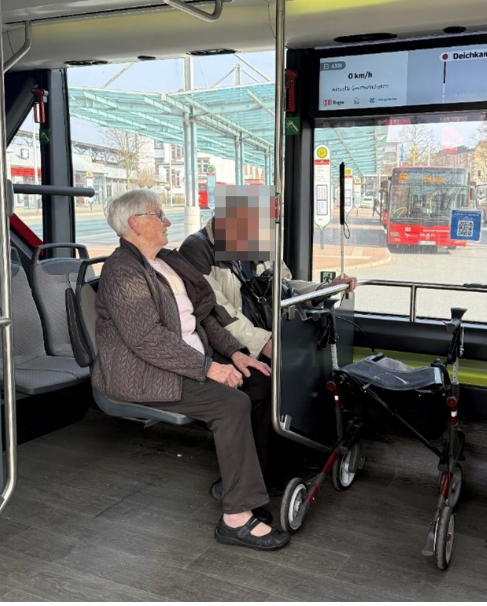
Until arrival, Maria was initially skeptical, as she could not imagine that a vehicle could drive automatically. Her skepticism changed when she saw the red minibus for the first time and realized how familiar it felt. The vehicle features an interior layout similar to a standard bus, an easily accessible space for her walker, and even the ability to lower itself to make boarding easier. She immediately noticed that boarding was possible even without deploying the ramp, as the bus pulls close to the curb and lowers itself. In other situations, the mechanical ramp could be extended easily by assisting persons. Maria tested boarding and disembarking from the vehicle several times at different stops. She openly shared her impressions. Overall, the reactions were strikingly positive and refreshingly honest.
Familiarity and Trust
The vehicle was described as “a proper bus – something you know”. Its traditional, no‑frills design, free of playful or experimental elements, aligned well with user expectations and supported trust, especially important for older passengers and first‑time users of automated systems. The smooth ride dynamics and the low noise level were appreciated. Seating and interior layout are outlined as follows:
- Seats were of good size.
- All seats faced the direction of travel.
- There was sufficient space for a walker.
- Without obstructing movement, the walker can be held and observed when sitting next.
- Stop request buttons are in reach range of the seat.
- Handrails and grips were good visible and at expected spots.
These details might appear small, but they significantly affected perceived comfort and safety. Interestingly, she was also fascinated by the on‑board screen visualising sensor data, watching how the vehicle “perceives” its surroundings – a reminder that transparency can spark curiosity and delight, even among senior users.
The visit also surfaced important accessibility gaps:
- A gap of around 15 cm between the vehicle and the curb even on same vertical level (kneeling position) was noted as potentially problematic - While manageable for experienced walker users, this may pose serious barriers for others.
- The mechanical ramp was perceived as not operable without help.
- Maria didn't find request buttons in and outside the AV for the essential kneeling function.
- Additional handrails near the door (two were suggested) would greatly improve stability and confidence during boarding and alighting.
- The announcements of next stops in the vehicle were not noticed due to a mild hearing impairment. One reason may be the low sound level and the poor sound quality of the speech.
- The booking of a ride by smartphone app was not possible for Maria due to complexity and missing digital experience. Help was required from the accompanying team. This is a clear blocking point for Maria to use the service.
- Maria asked the question: "How can I inform the bus that I need some more time or is there an automatic detection?"
These observations underline how small infrastructural or design details can make the difference between usability for some and accessibility for all.
Emotional Feedback that Matters
Perhaps most telling was the emotional response from Maria. She expressed genuine appreciation for the vehicle and regrets that the service with this particular vehicle has been discontinued. She can very well imagine using an autonomous minibus to bridge the 1 km distance from her home to the nearest bus stop or, even better, to continue to the city center without change. But she is afraid that she is not able to use a smart phone for booking.
Takeaways & Summary
The Herford visit highlighted several key lessons:
- Conservative design can be empowering: Familiarity builds trust.
- Boarding is the critical moment for accessibility: vehicle kneeling is an effective solution for fix stops. It is already known by users.
- PRM users are not just testers – they are co‑designers through lived experience.
In fact, Maria had visible fun getting on and off the bus several times – confidently and without assistance. As an experienced walker user, she navigated the process with ease and enthusiasm. She decided to make a second relaxed round trip after a pause and she highly appreciated the very kind explanations of the technical staff this time. When safely reaching the final stop only one of her questions remains open: "Who has to pay the fine, if the autonomous bus is driving too fast!"